

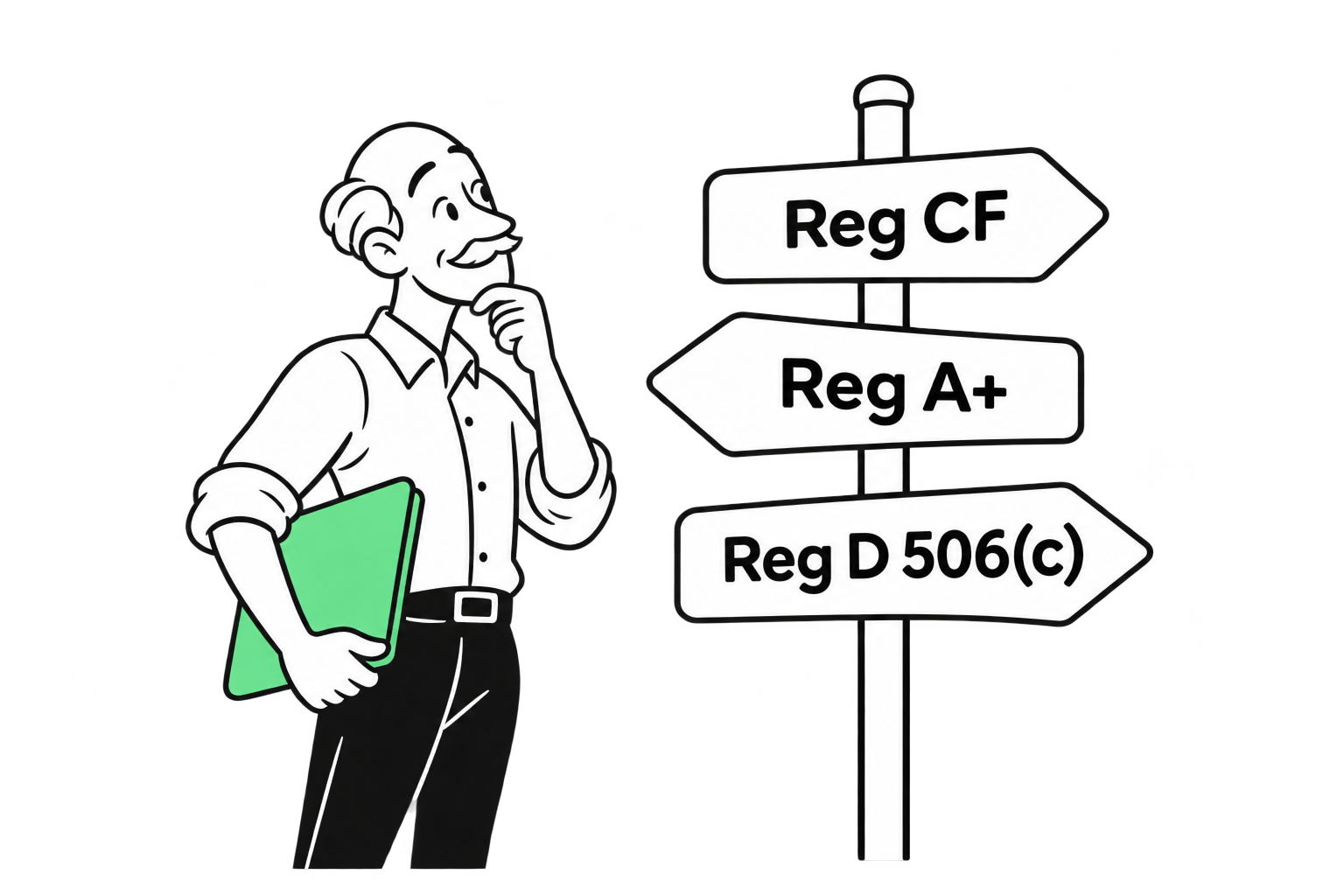
All three let a private company raise money without a full IPO, and each one trades off size against cost:
- Reg CF is the fastest and cheapest. You can raise up to $5 million a year from anyone.
- Reg A+ lets you raise up to $75 million from the public, but costs more and takes months to get SEC qualification.
- Reg D 506(c) has no cap and lets you advertise, but only accredited investors can invest, and you must verify that they are.
Which one fits depends on how much you need, who your investors are, and how much time and budget you have before you launch.
The comparison at a glance
| Reg CF | Reg A+ Tier 1 | Reg A+ Tier 2 | Reg D 506(c) | |
|---|---|---|---|---|
| Maximum raise | $5M in 12 months | $20M in 12 months | $75M in 12 months | No limit |
| Who can invest | Anyone | Anyone | Anyone (non-accredited investors have limits unless the shares are exchange-listed) | Accredited investors only |
| Investment limits | Yes, for non-accredited investors, based on income and net worth | None | 10% of annual income or net worth for non-accredited investors | None |
| Public advertising | Yes, within the Rule 204 tombstone rules after filing | Yes | Yes | Yes |
| Where it runs | Through a registered funding portal or broker-dealer | Your own site, a platform or a broker-dealer | Your own site, a platform or a broker-dealer | Anywhere |
| Financial statements | Certified, reviewed or audited, depending on the raise size | Not required to be audited | Audited | No set requirement (investors will ask) |
| Regulator review | None before launch (Form C filed with SEC) | SEC qualification plus state review | SEC qualification (state review preempted) | None (Form D filed after first sale) |
| Time to launch | Weeks | Months | Months | Weeks |
| Ongoing reporting | Annual report (Form C-AR) | Exit report only | Annual, semiannual and current reports | None to the SEC |
| Resale of shares | Restricted for one year | Freely tradable | Freely tradable | Restricted |
Regulation Crowdfunding (Reg CF)
Reg CF is the usual first step for startups and consumer brands with a loyal audience. You file a Form C with the SEC and launch on a registered funding portal such as Wefunder, StartEngine or Republic. New to it? Start with what equity crowdfunding is.
Best for: raises up to $5 million, companies with customers or fans who want to invest, and founders who need to move quickly.
What to know:
- Financial statements scale with the raise. Small raises need statements certified by the CEO, mid-size raises need statements reviewed by an accountant, and larger raises need audited statements. First-time issuers get some relief at the top end.
- Non-accredited investors can only put in a limited amount each year. That doesn’t usually hold a raise back, because most Reg CF checks are small, but it shapes your targets: you need many investors.
- Advertising is allowed but structured: testing the waters before filing, and tombstone ads after filing. See our guide to Reg CF marketing rules.
- You must file an annual report every year until you qualify to stop.
Regulation A+ (Reg A+)
Reg A+ is sometimes called a “mini-IPO”. You file a Form 1-A offering statement, and the SEC reviews and qualifies it before you can sell. Tier 2 is the one most companies use, because it overrides state securities review.
Best for: companies raising $5–75 million from a large community, especially consumer brands with a big audience, and companies planning a later listing.
What to know:
- SEC qualification typically takes a few months, and legal and audit costs are significantly higher than for Reg CF.
- Tier 2 requires audited financials and ongoing reporting: an annual report (Form 1-K), a semiannual report (Form 1-SA) and current event reports (Form 1-U).
- You can test the waters before and after filing, and advertise freely once you’re qualified. Accuracy rules still apply to everything you say. More on Reg A+ marketing.
- Shares aren’t restricted, which makes later trading or a listing easier.
Regulation D Rule 506(c)
Rule 506(c) is a private placement with one key difference from the traditional 506(b): you can advertise publicly. In exchange, every investor must be accredited, and you must take reasonable steps to verify that, usually through tax documents, bank statements or a letter from a professional.
Best for: larger rounds from accredited investors, real estate and fund offerings, and companies that want to advertise without the cost of Reg A+.
What to know:
- There’s no cap on the amount raised and no SEC review before launch. You file a Form D within 15 days of your first sale.
- Verification adds friction for investors, so conversion rates are lower than on a Reg CF campaign page.
- Many companies run a 506(c) round alongside a Reg CF raise, so accredited investors can write bigger checks. Get legal advice on how to structure the two together.
Which one should you choose?
- You need under $5M and have an engaged community: Reg CF.
- You need $5–75M and can afford audits, legal work and a longer timeline: Reg A+ Tier 2.
- You’re raising from wealthy individuals and want to advertise: Reg D 506(c).
- You want both the crowd and big checks: a Reg CF raise combined with a 506(c) round, structured by counsel.
- You’re unsure whether there’s demand: test the waters first. Reg CF and Reg A+ both allow it.
The marketing work is similar for all three: build an audience, convert it into reservations, then drive investments. What changes is the scale of the budget, the length of the campaign and the rules for each message.
Sources
- SEC, Regulation Crowdfunding: A Small Entity Compliance Guide for Issuers
- SEC, Regulation A: Small Entity Compliance Guide
- SEC, Private Placements under Regulation D investor bulletin and the Rule 506 of Regulation D overview
- 17 CFR 227.100 (Reg CF limits), 17 CFR 230.251 (Reg A tiers), 17 CFR 230.506(c)